
Search Visibility Agent 2.0: Complete Walkthrough & Activation How-To


If you have been following The AI-Augmented Marketer newsletter, you already know the backstory. In the two-part series that started this conversation — The Search Game Has Changed. Most Agencies Haven't and I Built an AI Search Visibility Agent. Here's What Happened — I wrote about why AI-mediated search is reshaping how buyers find information, why most agencies are not yet equipped to help their clients navigate that shift, and what I built to start filling that gap.
After publishing those two pieces, the response from marketers was clear: the concept resonated, but what they actually wanted was a way to see how they compared — not against generic best practices, but against the specific companies they competing with for visibility.
So I expanded the agent to be more competitive. Literally. And alongside it, I built a model for turning the findings into strategy (Why not?!) This post walks through both: the three reports the new agent produces and SamaraGlobal's AI Visibility Model which gives these reports their strategic meaning.
What Changed in Version 2.0
Version 2.0 is the original Search Visibility Agent with oompf. Now, a competitive intelligence layer is built directly into the workflow. You can input your own website for comparison against up to three competors and assess authority on up to 20 topics, phrases, themes, or keywords.
Where Version 1 accepted a single website, Version 2.0 accepts: a target website, up to three competitor websites, and up to twenty industry topics or search themes.
The Agent's analysis runs in two phases:
Phase 1 runs the full original audit on the target site — technical health, AI answer-readiness, AI visibility gap analysis, content opportunity identification, content brief generation, and page rewrites. Nothing from Version 1 was removed.
Phase 2 crawls the competitor sites and maps their topical coverage against the target, producing a competitive dashboard and gap matrix.
Note: The twenty topics you enter are the foundation of the entire competitive analysis. Think of them as your competitive battleground (the territory you are fighting to own in AI search.) The agent crawls all sites and asks a simple question for each topic: Who is covering this, and who is not? The result is a coverage score for each site and a gap matrix showing exactly where you are absent, where competitors are building authority, and where nobody has claimed the territory yet.
The Model That Brings the Reports to Life
The agent produces data. The model I created turns that data into strategy, one stage at a time. SamaraGlobal's AI Visibility Model organizes AI search visibility into six stages. Each asks a strategic question answered by a specific section of the agent's output:
Stage 1: Discoverability: Can search engines and AI systems find your content?
Stage 2: Comprehension: Can they understand what the content means?
Stage 3: Authority: Does the content demonstrate expertise and credibility?
Stage 4: Coverage: Are you answering the questions buyers are actually asking?
Stage 5: Citation Readiness: Can AI systems easily extract and reuse your information?
Stage 6: Competitive Advantage: What are competitors covering that you are not?
Keep these six questions in mind as you read through the reports below. By the end of this post, you will be able to look at any section of any report and know exactly which pillar it speaks to and what to do about it.
The model's methodology and how it is applied in client engagements is available here:
The Three Reports
Version 2.0 produces three HTML reports, each designed to be opened in a browser and shared directly with a client, content team, or web developer.
Report 1: The Executive Summary
The Executive Summary covers the target site only. It answers the foundational question: before we look at competitors, how does this site stand on its own? At the top, three score cards give an immediate read: Technical Health score and grade, AI Answer-Readiness score and grade, and a navigation link to the Competitive Dashboard.

The Technical Health section lists every issue the crawler found, organized by severity ( critical first, then warnings, then informational items.) Each is linked to the specific page URL where it was found. This is a working document designed to be handed directly to a developer or web team. The most common critical issues are:
Missing H1 headings (no clear signal to search engines or AI systems about what the page is about)
Duplicate title tags (indexing confusion that causes both pages to underperform)
Canonical tag errors (authority dilution and duplicate content problems)
Warnings are less urgent but still meaningful. Title tags that are too short or too long, missing meta descriptions, and absent schema markup all reduce how clearly a page communicates its subject to automated systems.
The AI Answer-Readiness Section
Every crawled page is scored on how well its content is structured to be retrieved and cited by AI answer engines, sorted lowest to highest so the most urgent cases appear first. For each page the report shows the score and grade, the page's top strength, its critical weakness, three specific recommendations, and a rewrite flag if the score falls below 60.
A page can be well-written and technically sound and still score poorly here because citation readiness is not about quality, it is about structure. The most common weakness is unstructured content: flowing prose with no headings, bullet points, or FAQ sections. AI systems need content they can cleanly extract and present as an answer. Pages flagged for rewriting receive a full structural rebuild (not a cosmetic edit.)
The Recommended Next Steps Section
At the bottom, a Recommended Next Steps section auto-generates a prioritized action list derived directly from what the audit found. A typical list looks like this:
Fix critical technical SEO issues (missing titles, duplicate content, missing H1 tags.)
Resolve warnings (title length issues and missing meta descriptions.)
Rewrite low-scoring pages (pages below 60 are unlikely to be cited by AI search engines.)
Add schema markup to key pages.
Review the Competitive Dashboard and use the Content Brief Index to close competitive gaps.
Report 2: The Competitive Coverage Dashboard
The Competitive Coverage Dashboard is where the competitive intelligence lives. It answers the question every marketer actually wants answered: who is winning the content coverage battle on the topics that matter in our market. And where is the opportunity to get ahead? The dashboard measures content presence on the topics most likely to determine whether an AI system cites your site or a competitor's when a buyer asks a relevant question.

Topic Coverage by Site: a bar chart showing coverage percentage scores for all sites side by side measures content presence (not quality.) A site can have excellent content and score zero if it does not address the defined topics.
The Content Gap Matrix: maps every industry topic against target site vs competitor sites with a tick or cross, revealing two types of opportunities:
Catch-up gaps: a competitor covers the topic and you do not. You are behind and need to close the distance.
White space opportunities: nobody covers the topic yet. The first site to publish strong, well-structured content here has a genuine opportunity to become the default AI citation on that subject.
Priority Gaps: every topic your target site is missing, regardless of whether competitors cover it. Your content to-do list. Every item has a corresponding Content Brief waiting in the Content Brief Index.
Strategic Insight: a plain-language summary of your overall coverage position and a direct recommendation for prioritizing your next 90 days of content production.
Report 3: The Content Brief Index
The Content Brief Index is the bridge between analysis and action. Every gap identified in the competitive dashboard and the AI visibility analysis becomes a numbered, clickable content brief.
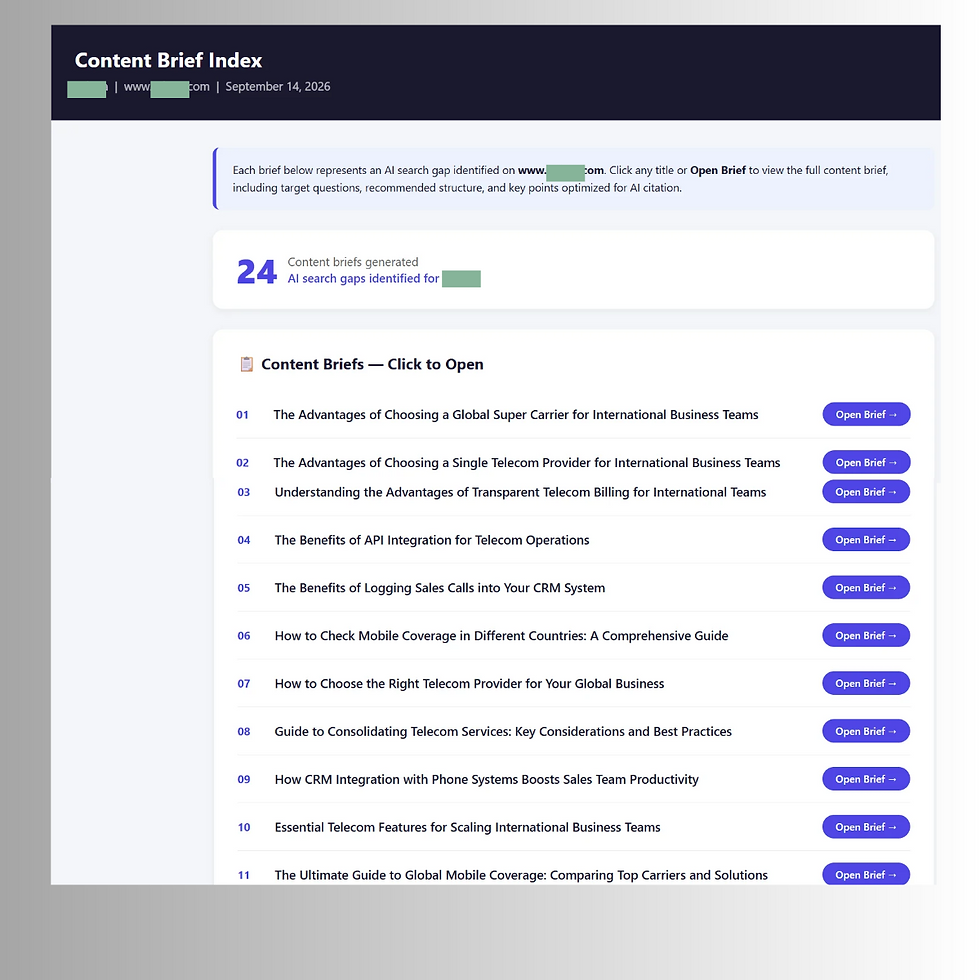
The Content Brief Index is a production system to work from. Every Content Brief is ready to hand to a writer, a content team, or an AI writing tool. Each brief is optimized for AI citation from the first word. The below condensed example is for an actual startup in telecom.
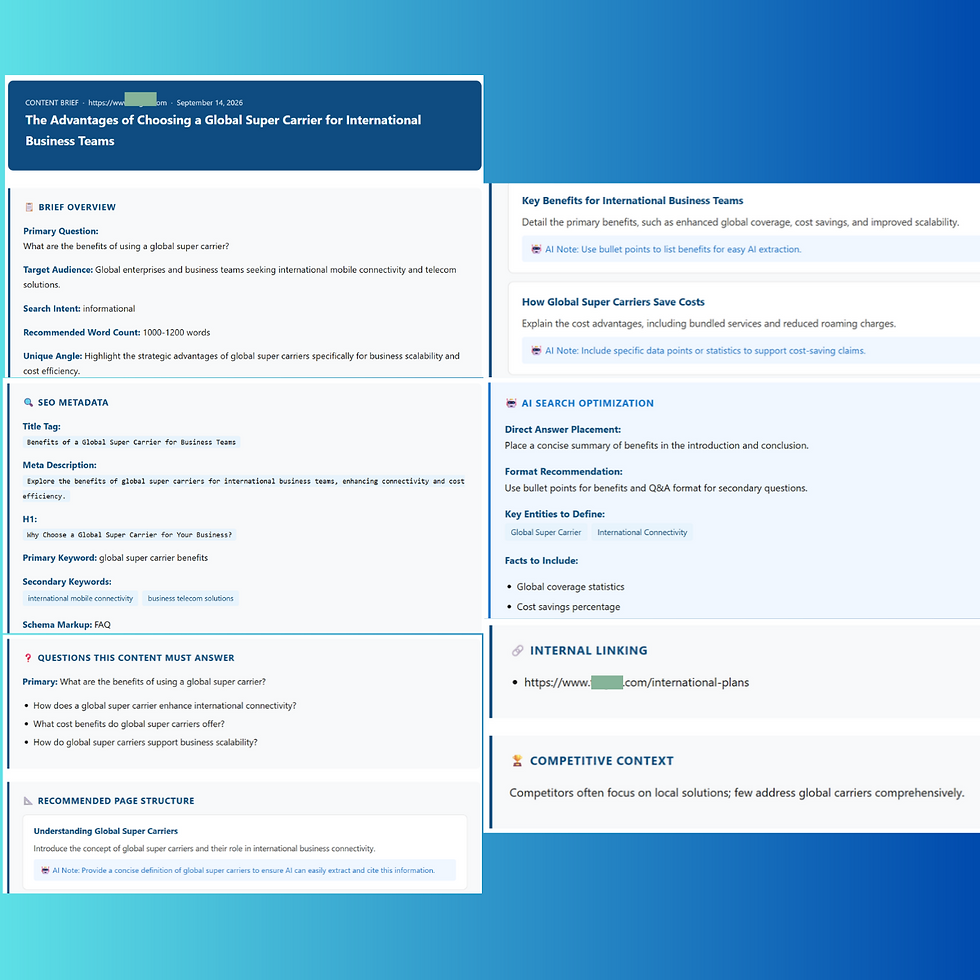
Each Content Brief includes:
Brief Overview: primary question, target audience, search intent, recommended word count, and a unique angle differentiating the content from what already exists.
SEO Metadata: ready-to-use title tag, meta description, H1, primary keyword, secondary keywords, and schema markup type.
Questions This Content Must Answer: derived from the AI search gap analysis and Perplexity API responses, not invented.
Recommended Page Structure: section-by-section outline with embedded AI Notes explaining how to structure each section for AI extraction and citation.
AI Search Optimization: where to place the direct answer, what format to use, which entities to define, which facts to include.
Internal Linking: a suggested link to an existing page on the target site.
Competitive Context: how competitors address this topic / where the differentiation opportunity lies.
A Note on the Data Behind the Analysis
The agent uses two APIs working together:
OpenAI generates the questions — identifying the topics the site covers or should own, then generating the specific questions a real user would ask about each.
Perplexity answers those questions — the agent submits each question directly to Perplexity's API and observes the actual AI search response, recording which sites are cited, which are absent, and which topics have no strong source at all.
The data is real. What we measure is whether your site appears in those responses.
I am deliberate about calling this an AI Visibility Layer rather than a search volume tool. We are observing citation patterns, not measuring keyword demand.
SamaraGlobal's AI Visibility Model
The agent surfaces the evidence. The model gives it strategic meaning. Reading three reports without a structure for interpreting them produces data, not decisions.
SamaraGlobal's AI Visibility Model organizes the findings across six stages; each is a question your content either answers or fails to answer for AI search systems. The stages follow a logical sequence: a page must first be findable, then understandable, then credible, then comprehensive, then extractable, then competitive. Weakness at any stage limits what is possible at the next. This also prioritizes fixes in a step-by-step attack plan.
Stage 1 - Discoverability: Can search engines and AI systems find your content? Evidence: Executive Summary → Technical Health
Discoverability failures are the most urgent to fix. A well-written page that can't be found or correctly indexed will never be cited. The technical health table lists every structural barrier: missing H1s, duplicate titles, canonical errors.
Stage 2 - Comprehension: Can they understand what the content means?
Evidence: Executive Summary → Technical Health + AI Answer-Readiness
Comprehension failures show up in two places. In technical health: title tag issues, missing meta descriptions, absent schema markup. In AI readiness: low entity clarity and factual structure scores, and unstructured content that AI systems cannot parse cleanly.
Stage 3 - Authority: Does the content demonstrate expertise and credibility?
Evidence: Executive Summary → AI Answer-Readiness
Authority separates pages that get cited from pages that get passed over. Pages that score well have named expertise, specific claims, and concrete data. Pages that score poorly read like marketing copy: claims without evidence, benefits without specifics.
Stage 4 - Coverage: Are you answering the questions buyers are actually asking? Evidence: Competitive Dashboard → Content Gap Matrix + Content Brief Index
The gap matrix shows who covers what across all three sites. Catch-up gaps show where competitors are ahead. White space opportunities (topics nobody covers yet) are the highest-value plays. The first credible source on an uncontested topic has a genuine chance to become the default AI citation.
Stage 5 - Citation Readiness: Can AI systems easily extract /reuse your information? Evidence: Executive Summary → AI Answer-Readiness
**This is the stage that no traditional SEO tool measures! Citation readiness is about structure (not content quality.) FAQ sections, bullet points, answer-first paragraphs, and tidy summaries are the signals that determine whether content gets cited or passed over.
Stage 6: Competitive Advantage: What are competitors covering that you are not? Evidence: Competitive Dashboard → Topic Coverage + Content Gap Matrix
The coverage bar chart gives the headline picture. The gap matrix reveals the strategy. Catch-up gaps are competitive liabilities. White space opportunities are where the real advantage is built. In AI search, being the first credible source on an uncontested topic is worth far more than being the fifth source on a crowded one.
Final thoughts
The companies that will win in AI search are not the ones that stuff keywords into pages. They are the organizations that become the most useful, most understandable, and most citable sources in their category.
That requires understanding where competitors are building authority, which questions remain unanswered, and where the largest visibility gaps exist. That is what this agent surfaces. And turning those findings into a content strategy that moves the needle is where the real impact begins.
If you would like to understand what this analysis could reveal about your own website or your clients' websites, I would be glad to talk!
→ Learn more about the SamaraGlobal's AI Visibility Model
Read Part 1: The Search Game Has Changed. Most Agencies Haven't
--
Samara H. Johansson is a senior B2B marketing consultant specializing in developing and then activating global brand positioning, messaging frameworks, and AI-augmented marketing strategy to generate leads. She works with companies navigating growth, repositioning, and international market expansion. Learn more at SamaraGlobal.com and subscribe to The AI-Augmented Marketer on LinkedIn.


Comments